

In this issue:
- The Economics and Politics of Pacing the Frontier—A slower-than-maximum pace of improvement for AI could still mean an acceleration from here. And there's still plenty of room to find new places to use existing models. Pacing the frontier is bad for AI labs' current economics (though less so for other parts of the AI stack), but they may be making the bet that it's better to make progress slower than to make big mistakes or to let someone else write their rules.
- Reflexive Funding—One reason Oracle's equity is valuable because it can deploy lots of borrowed money at high returns, and its cost of debt is low because of the equity cushion. This whole setup has a lynchpin named Larry.
- Insider Trades—Prediction markets as a honeypot for revealing untrustworthy people.
- Reference Implementation—Choosing a software stack is shifting from a practical question to a philosophical one.
- Margins—Sometimes, gross margin means too many things to be a useful standalone metric.
- Law Enforcement—Big Tech Sees Like a State.
Talk to this post on Read.Haus.
The Economics and Politics of Pacing the Frontier
Dario Amodei has called for slowing the pace of AI, though to a pace where "Progress will still seem fast," a view endorsed by Sam Altman, Demis Hassabis (a little more guardedly), and Elon Musk. The last time people responsible for that much market cap all pivoted to a new priority over the weekend was probably when Lehman went under. It's a big deal![1]
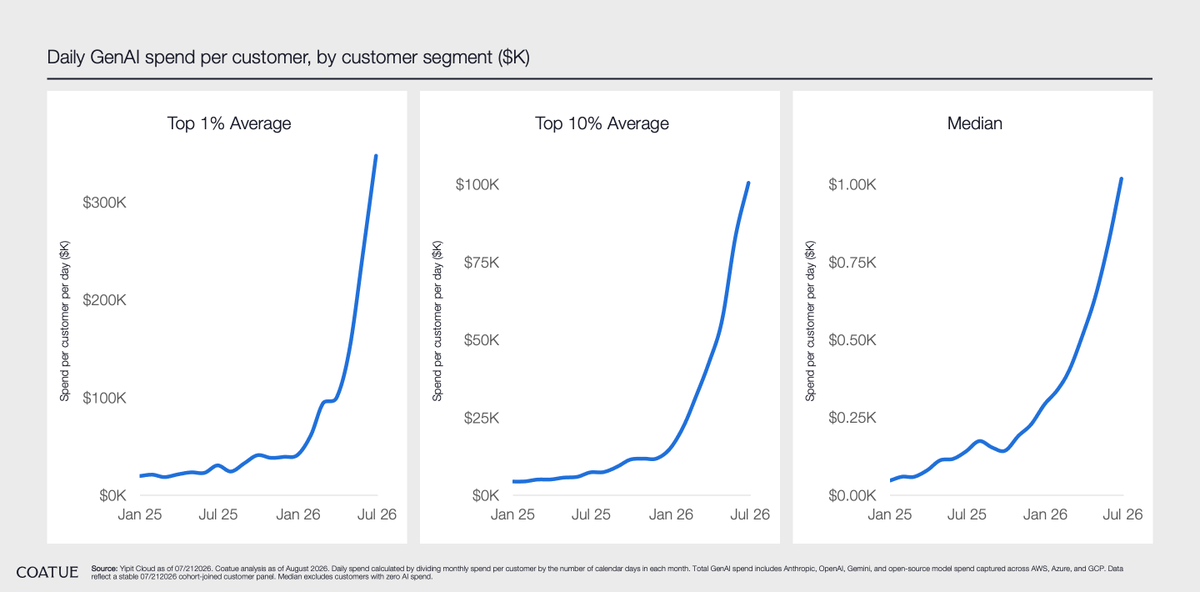
But it's also hard to assess how surprising it is; as implausible as it sounds, 2026 has been a big inflection in AI usage and capabilities: according to data from Coatue by way of Yipit, spend via cloud providers has surged 15-20x across every major cohort in the past 18 months, with the bulk of increase coming in 2026.
In one sense, an agentic harness that helps you use LLMs to complete lengthy tasks is not that big a technical leap, and people were working on systems like this on their own; if you had nested if/then statements that included an OpenAI API call and decided what to do next based on what that call returned, you technically had a lightweight agentic harness right there. But there's a qualitative difference if you reach the point where you can broadly describe a task and AI can break it down intelligently, do various parts of it in parallel, and report the results. Specifically, three of the big changes regardless of model capability are:
- A human in the loop, but in a longer loop where they aren't necessarily monitoring what their agent does in real time,
- A higher volume of work that makes it less likely that a human would manually review every incremental output, or even the code from the final product,[2] and,
- A longer tail for the distribution of effective capabilities. Sometimes, agents will work for a long time on some task before they finish, and time allows weirdness to compound and propagate.[3]
About a year ago, The Diff considered a different scenario: what if there's a spate of disappointing training runs, and capabilities leveled off at then-frontier levels? The basic answer was that some parts of the capex cycle are slow-moving, and that even if some marginal datacenter projects get canceled, there will be cases where the original underwriting assumption was an internal rate of return in the teens, and the choice facing capital allocators is whether to move forward with something that offers a single-digit return or just take a loss. More money being a better deal than less, we'd still see an enormous increase in the world's GPU fleet. Which would put pressure on token prices, perhaps even making them like crypto, where the price is determined by whatever makes you unplug the GPUs.
When OpenAI quantified the pace of their own researchers' internal token consumption, they showed rapid agent adoption since the start of the year, and faster growth since summer. One live possibility is that a deliberately slower pace of releases would still feel like an acceleration from the previous pace of AI improvement; last week they were talking about how they'd been able to accelerate some planned releases, so for them, pacing the frontier might just mean doing whatever they'd been planning back in April.
In one sense, this whole setup seems to favor lab economics: they typically dump an unpredictable but large sum into training models, and then get better and better unit economics from those models, until they're obsolete. Getting the same unit economics and cutting a big source of operating expenses seems helpful, and even the kind of thing that looks like industry collusion—OPEC was pacing the frontier of hydrocarbon consumption by reducing oil supplies and spending less on exploration, after all.
The problem with that view is that models have more pricing power when they're literally the best tool for some specific job. Particularly in adversarial environments like law and finance, people don't necessarily want to use the best model in the world, just a better one than the person they're negotiating with. Software engineers are so expensive that they can justify a lot of token spending (though determining the return on the average token, much less the marginal one, remains hard—people are working on this). So if companies specifically forswear launching powerful models, everyone's incentive is to avoid beating each other too much on any given benchmark—they may even have an incentive to benchmin if they can be quantifiably similar to one another, but feel qualitatively better because they're optimizing in a direction benchmarks don't perfectly capture. Even if there are slight customer preferences—maybe an Anthropic model is 2% better than average for analyzing contracts but 1% worse at compiler optimization—this won't drive as much pricing power. Meanwhile, companies that agree to pace the releases of their best models are, in effect, agreeing not to maximize the gap between proprietary models and open-weight ones.
It will be weird to have an opaque, technocratic quasi-institution that's determining the speed at which a new technology is deployed. But there's a good model for it in the Federal Reserve: an institution that makes complicated, specialized tradeoffs in some often-complex field, and that also determines how to communicate those decisions and the reasoning behind them. Over the Fed's history, many of these have changed; the federal funds target rate used to be something that had to be inferred from the Fed's trades (so there were incidents that sound bizarre today, like a 1989 rate-cut-that-wasn't). They're subject to lots of scrutiny, but political influence on them has a long lag. And they originated from the infrastructure that financial institutions had built between themselves; it was a formalized government version of an existing private sector arrangement.
A more recent illustration of that evolution is the North American Electric Reliability Corporation, or NERC. This started out as a voluntary organization of utilities trying to increase grid-wide reliability; over time its responsibilities and authority evolved (as did its name; it’s always been NERC, but it used to be the National Electric Reliability Council instead. After the 2003 blackouts, the government created a legal status for electric utility self-regulators, and NERC applied for and got that status. Self-regulation tends to be more flexible, for better or for worse, but that means that when there’s a point of maximum uncertainty, the ideal structure can be an opt-in organization that can more or less flip a switch and become something quasi-government instead.
It's been a good few years for people who like to draw trendlines on log-scale charts, and that doesn't have to persist long for AI to join the ranks of systems that are important enough that there's someone senior in the government who's responsible for regulating them. But the AI industry does not want to be run by the median voter if they can at all help it; building a self-regulatory body that can be subsumed by the government but still run quasi-independently might be their best bet.
Though what we have right now is the timing of the announcement, not the timing of the decisions; The Information reports that they'd already been discussing some kind of collective safety organization ($), so Dario's essay might have been a way to get things moving again. ↩︎
This is a surprisingly contentious issue among software developers right now. On one hand: it feels pretty irresponsible to use code you've never actually looked at in production, even if you've also told your agent to write good tests and perhaps manually inspected those. On the other hand, it will probably be similar to the story of higher-level languages: proprietary C compilers used to advertise that they produced assembly as an intermediate output, so you could always read the real code, and the first users would have overwhelmingly been people who already knew how to write assembly, and, because of how low-level C is, also had a good idea of what assembly would be produced. They seem to have switched to looking at the assembly only when performance was unexpectedly slow. But compilers kept getting better, and improvements in hardware quickly made it possible to be productive in higher-level languages. This trend will probably continue; very few programmers were reading assembly in the pre-LLM-assisted-coding era, though the ones that could do that had better mental models of what computers do. ↩︎
There is a fairly silly semantic argument that in the HuggingFace situation, the models weren't actually misaligned because they were told to do some cybersecurity task, and technically hacking an unrelated third party is a kind of cybersecurity. Anyway, it turns out that some of the other hacks involved pure information-seeking tasks. But what is worth thinking about is the model of "thinking" that applies to agents that run in parallel and have some capacity to pass messages between themselves. In one sense, these are separate "minds" that all make independent decisions. In another sense, they're all instances of either a single model or a handful of them, with any differences chalked up to the randomness that's necessary for an LLM to do anything at all. To the extent that it's useful to think of them as minds, they're a kind of blurry, distributed one. (We're all on that spectrum; leaving your gym clothes out the night before is the human equivalent of editing a wiki so a future instance of yourself remembers what previous-day you wanted.) ↩︎
You're on the free list for The Diff. This week, paying readers got a look at how AI does and doesn't show up in GDP growth ($), and thoughts on Oura, and the challenges of accounting that accurately reflects unit economics ($). Upgrade today for full access.
Diff Jobs
Companies in the Diff network are actively looking for talent. See a sampling of current open roles below:
- The next great American print magazine hyperstitioning abundance through gorgeous techno-futurist aesthetics and the highest quality long-form writing on entrepreneurship, technology, and capital is looking for a Chief of Staff to execute on a number of interesting growth projects. One day you’re standing up a physical bookstore (and modeling the attendant unit economics), the next you’re producing a podcast or mailing coffee table books to cultural tastemakers, throughout it all you’re focused on getting things done. If you have an operational / analytical toolkit (e.g, banking, consulting, startups) and want to work with a team shaping culture, please reach out. (Austin)
- A top prop trading firm is looking for people who combine exceptional quantitative ability with the judgment and relationship instincts to build critical financial partnerships and lead high-stakes negotiations. Candidates may come from markets, finance, or further afield; what matters is this combination of abilities, strengthened by the perspective that comes with experience. (NYC)
- A top prop trading firm is looking for people with exceptional strategic thinking and quantitative skills to help the firm model and manage its financing risk and strategy. Open to candidates from a range of analytically demanding fields.(NYC)
- Ex-Bridgewater, Worldcoin founders using LLMs to generate investment signals, systematize fundamental analysis, and power the superintelligence for investing are looking for machine learning and full-stack software engineers (Typescript/React + Python) who want to build highly-scalable infrastructure that enables previously impossible machine learning results. Experience with large scale data pipelines, applied machine learning, etc. preferred. If you’re a sharp generalist with strong technical skills, please reach out. (Remote)
- Series A, Thiel-backed team building full-stack software, hardware, and chemistry to end water scarcity, is looking for an ambitious product engineer to help build operating platform and internal tools that weather modification operators can use to make weather, geospatial and flight data useful to plan, monitor, and review campaigns. If you’re excited to own product outcomes through deployment and are strong at turning messy problems into good product (using Typescript and React), this role is for you. (Los Angeles)
Even if you don't see an exact match for your skills and interests right now, we're happy to talk early so we can let you know if a good opportunity comes up.
If you’re at a company that's looking for talent, we should talk! Diff Jobs works with companies across fintech, hard tech, consumer software, enterprise software, and other areas—any company where finding unusually effective people is a top priority.
And: we're now actively deploying capital into early-stage companies through Anomaly. Our focus is on defense, logistics, robotics, and energy. If you'd like to chat, please reach out.
Elsewhere
Reflexive Funding
Here are two stylized facts that might underpin an investor's decision to invest in Oracle:
- An equity holder might say: the cash flow from Oracle's existing business gives them an unusually large capacity to borrow in order to build a massive cloud business.
- A lender might look at Oracle's $433bn market cap and say that that's a lot of implied value cushioning what is for a bit less debt, and they could also look at Oracle's last earnings report, and see that they'd converted that high market cap into $20bn of liquidity through an at-the-market offering that quarter.
In other words, each is willing to give Oracle a slightly lower cost of capital because the other is doing it, too. But this also means that Oracle is sensitive to anything that might affect sentiment, either about its shares' long-term upside or the possibility that their value might be permanently impaired. So, Larry Ellison decided to sell $7.5bn of shares, and then changed his mind ($, WSJ). He has other demands on his liquidity, like financing a big media merger, so he has a perfectly reasonable excuse to convert some Oracle shares into cash. But Oracle is trading under half of its 52-week high. If shareholders are watching bondholders, bondholders are watching shareholders, and everyone's watching Larry Ellison, his sales can be pretty expensive.
Insider Trades
There are a few more Polymarket insider trading investigations going on. At one level, the frequency of these kinds of trades is a symptom of financial nihilism, and a depressing sign of how quickly recreational gambling has permeated culture. On the other hand, the government actually has an unusually effective means of punishing these insider traders: they get permanently branded as untrustworthy and incompetent, in that they did trades on a platform that only gets more scrutiny over time, and that would keep getting easier to analyze. And in general, just the fact that they knew something worth trading on instantly narrows down the list of suspects. The markets themselves don't want insider trading; it hurts the sharps they need to provide their service and the gamblers who make it so profitable. We may end up thinking of prediction markets as a wonderful honeypot that identified everyone who's ever been trusted with more information than they should have been. Which would actually be a positive externality that might balance out some of the more broadly negative impacts of gambling.
Reference Implementation
Shopify is rewriting their Shop mobile app, switching from one cross-platform version (React Native) to separate Android and iOS versions, and they explicitly cite agentic coding as what makes this possible. LLMs do some very strange things to what it means to use a particular programming stack. In a sense, if you have a sufficiently good reference implementation for some software, and a sufficiently thorough set of tests, you can make it native to whichever platform you choose, with "sufficiently" doing a lot of work in both cases. More realistically, it is easier than it used to be to maintain two different versions of a program, and to ensure that they have similar output.
Software engineering interviews naturally spend time talking about developers' preferred software stack, and one effect of agents is that this has turned from a practical skills-based question to one that's more a way to kickstart a deep philosophical discussion. In effect, the modern version of that question means: if you were asking some superintelligent but sometimes unreliable friend to solve a problem for you, what notation would you prefer that they use, both for your ability to review their work and their ability to think it through? And what's the level of complexity at which this is not the relevant consideration, and where it's important to go native from the start? Shopify says that they still needed software engineers with expertise in the mobile native platforms to review code and cut down on bloat, so we're not at the point where you can literally tell the model to think through the problem in one language, then implement it in whatever's fastest, or uses the least memory, or whatever the relevant consideration is. Paradoxically, we're closer than ever to that world—but, at least for this project, human expertise remains the expensive bottleneck.
Margins
The two topics on which smart people give themselves permission to sound a little dumb are politics and non-GAAP metrics. For politics it's forgivable—when you do it, your brain is running whatever subroutine helped Og and Throg coordinate to steal a particularly shiny rock from Grog—but but on metrics it's more peculiar. The numbers a company chooses to track its performance don't always happen to map perfectly to what accounting rules say, and companies are generally happy to explain why. For example, Anthropic has been criticized in a few places because this FT piece says they're claiming an 80% gross margin excluding revenue share to their distributors and the cost of training models ($). The second is pretty defensible: gross margin is supposed to capture the incremental cost of earning another dollar of revenue, and a fixed cost that can be amortized over more revenue shouldn't be part of it: if Anthropic sells twice as many Fable tokens at current pricing, it does incur a cost to serve those tokens, but it isn't paying for additional training. The distributor revenue share piece is more complicated, but there are two ways to look at it:
- Anthropic is measuring itself as if it's a manufacturer of inference that sells at wholesale prices to inference retailers. Investors should care about the (large) markup they get on costs, and focus less on the part of their cost structure that's fully passed through.
- If they did include this revenue share in their gross margin, it would make gross margin harder to interpret. If distribution partners get a bigger markup, that lowers gross margin—but it also implies that Anthropic has room to take a bigger cut! (To be fair, the fact that the gap exists also implies, more weakly, that they can't take that cut.) Whereas if their costs go up because compute is scarce and there are many bidders for it, Anthropic's pricing power is mostly unaffected but their economics are worse. The distributor cut is meaningful to Anthropic's economics, but is something that it makes sense for them to track separately from other costs—one number represents how well Anthropic turns electricity into intelligence, and the other how costly it is to route a given quantity of intelligence to the best buyer.
Law Enforcement
A good way to think about automation is that it works when there are many dimensions to a job, and there are some tasks that are extremely spiky on just one or a few of those. When that's the case, there's a positive return from being superhuman-at-X for various Xes. These can include physical strength, tolerance for repetitive labor, precision, etc. And one of the cases is risk: there are things that are worth doing, but not worth risking human lives to do, and for those we often use robots. Waymo now slightly fits into that category: a Waymo called the police about two passengers who turned out to have a ghost gun. In theory, a human cab driver can do the detecting and alerting, but that driver might understandably care about self-preservation once they realize that someone immediately behind them is armed. So this is yet another dimension on which self-driving cars are safer: they're hard to mug or intimidate so, when able, they'll promptly report suspicious activity to the authorities.
Disclosure: long GOOGL.