 THE DIFF
Today's issue of The Diff is brought to you by our sponsor, Works in Progress.
Longreads
- In Core Memory, Brendan Borrell writes about Alain Dessein, a French geneticist who's spent years treating parasites in some of the poorest parts of the world. Parasite load is an underrated feature of human history; they tend to slow us down and alter our behavior even if they don't kill us, and places with concentrated human populations tend to be great breeding grounds for parasites targeting humans. So they're one of the drivers of Malthusian dynamics: even if we find ways to create a consistent calorie surplus, that's ultimately just a way to feed those calories to various microbes, worms, bugs, etc. if we don't develop countermeasures. The rich world mostly does; we have access to clean water, unspoiled food, structures that insulate us from the elements, etc. Whereas poorer places tend to get more direct exposure to the worst nature has to offer. This piece is partly about treating people who are both desperately poor and desperately sick, but there's a nice transition to how what we learn from heavily parasitized populations can point us to medicines that we wouldn't have discovered on our own.
- Caucus.AI reports on the impact AI had on the 2026 election. The Diff partly line for a while now has been that AI-based disinformation will not be a big deal, because it's only believable if it's fairly real, and people already have polarized views. The person who thought Kamala Harris was going to sell red states to the UN in a deal financed by George Soros probably wasn't going to vote for her, anyway (and probably doesn't actually vote). And Trump is pretty disinformation-proof in that he's larger-than-life and doesn't feel bound by political norms, but does love getting attention and stirring up outrage, and he's a lot better at it than the average deepfaker. Inventing funny or outrageous Trump statements is one of those jobs where humans still beat the bots. The piece has much more, including one case where LLMs themselves fell for disinformation: the researchers created fake campaign sites for existing politicians, and for fictional races, and asked LLMs about them; these sites got cited. But this is a case where AI-driven red-teaming is making the world more secure: now, the existence of such sites is in LLMs' world models, and they'll try a little harder to make sure they're going to the official source.
- Chloe Pingeon on visiting the launch party for The Elephant, a new conservative publication that believes in AI risk. It's an interesting bit of anthropology about modern conservatives, who appear much more willing to hang out with people who are broadly aligned but disagree on some key issue, whereas on the left there's a lot more intra-movement sniping over things like Medicare for All, climate (until recently), or Gaza. How much of this is the result of more open-mindedness, less interest in issues, or a shortage of conservative-friendly parties with open bars is yet to be determined. But, per the piece above: it's a good idea for people to write about issue X framed for readers from movement Y when movement Y is opposed to, or indifferent to, X. Political coalitions bear minimal relation to how well different beliefs should correlate (just ask someone what all their microconstituencies have in common and consider how vague the answer is! "Us, we hate family values." "No, I want the economy to be as unfair as possible; it needs to work for some of us, not for all of us."). You get a more coherent body of opinions from a publication like this. And while it probably won't directly lead to a change in party policy, if it gets read by staffers, and by people who write editorials and choose what to cover at larger publications, it can shift things in a different direction.
- In The New Yorker, Jill Lepore compares socialism's current success in the US to the movement's previous high-water mark in 1912. Some of what socialists asked for has come to pass, at least on average—they wanted a five and a half-hour workweek, while five is the default and typical work is much easier. Some, they're still asking for: 114 years ago, the socialist party wanted to abolish the electoral college. Socialist candidates put up surprisingly strong numbers this cycle, though the ones who were newly-elected were replacing other Democrats, and Angie Nixon outperformed Harris by a smaller margin than other Democrats running for statewide office in Florida. So, it's a very political kind of upsurge, in that the story gets weaker if you dig into the statistics but the high-level headline gets the base excited.
- Joseph Bernstein reviews GTA VI for the NYT. If you're going to write for the paper of record, you have to do more than talk about how fun it is to get in a simulated shootout with cops (though he does address this point. Apparently, it's very fun). So this piece is partly a meditation on modern American hyperreality. I've had the same sense; it's been a while since I played any games in the series, but sometimes I'll look at which movies are playing in theaters or which books are on display at Barnes & Noble and feel like I'm looking at a Rockstar Games parody of the real thing. (Nick Fuentes encountered the in-game parody of Nick Fuentes during a livestream). The GTA series has tended to get less cartoonish as time has gone on, partly because of improvements in graphics and partly because, as the piece notes, the people who were furtively playing GTA: San Andreas in middle school now find a story about economically precarious parents more relatable. So Rockstar is performing the classic function of a parody: taking something real and exaggerating its most salient features to fix some definition of it permanently.
- In Capital Gains, a look at what people opposed to AI detection imagine its flaws might be, and what we can learn from investigating their hypotheses and finding out that they're wrong. It continues to be funny that people who spend all day in Claude Code are, temporarily, better at assessing the literary merit of short fiction than the judges of literary prizes. As someone who enjoys fiction, I'm hoping this is temporary; the programmers are very busy at the moment.
- A ReadHaus reader asks for more on the governance risks of reinstating Jensen Huang. I'm torn on the object-level issue, though it looks like either the board or the US government has made a final decision there. (Then again, this isn't Jensen's first drawdown.) In general, you want an executive to have protections against firing if your view is that they will sometimes make contrarian decisions that the average shareholder hates now but will be thankful for in a decade. In some cases, this can be an editorial decision that hurts a media business in the short term but makes them trustworthy over time; on the strategic side, it usually means big capital allocation decisions or tolerance for foregone revenue. It's a little unusual for dual-class stock to preserve someone's complicated personal life, though Sumner Redstone might be an accidental counterexample there. But in Huang's case, the specific protection seems to involve not getting in trouble in either his personal life or sanctions violation, and that's exactly when you don't want an executive to be hard to fire. The risk the board runs is that they're overseeing someone who's immune to oversight and hasn't been strictly responsible. Even if he's a legendary manager who built an incredible company, there are some risks that outweigh that.
You're on the free list for The Diff. This week, paying subscribers read about when the best way to participate in a boom is to sell a pure commodity ($), the rising interest rate on tech debt ($) and the attendant restructuring, and the efficient frontier between presenting analysis in Excel and as a dashboard ($). Upgrade today for full access.
A Word From Our Sponsors
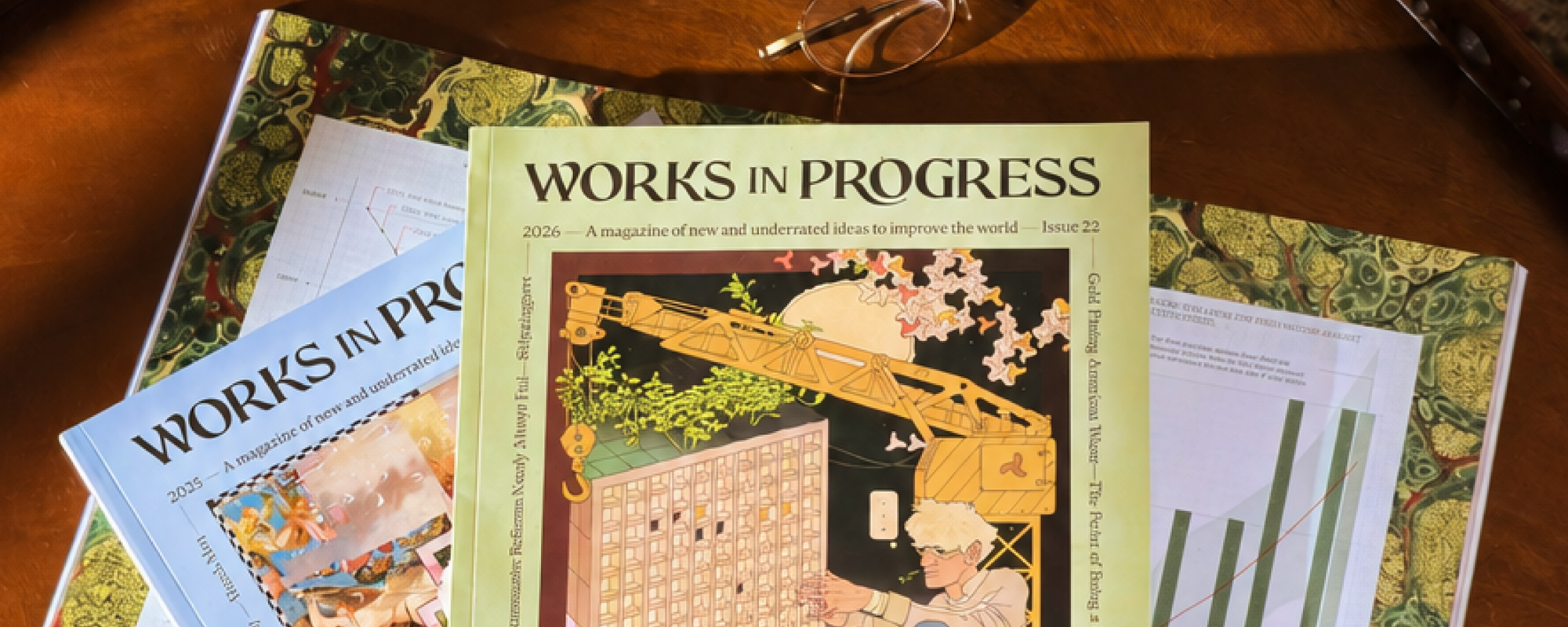
Footnote 59 of this year’s White House report on American science cites a longform article on why companies stopped building their own Bell Labs. It came from Works in Progress. So did two of Dario’s sources in the footnotes of “The Adolescence of Technology,” and the essay on the economics of architectural beauty that the New York Times spent an entire column answering.
When the people running startups, funds, newsrooms, and government bodies are looking for source material, they reach for Works in Progress. The print edition lands on their desks six times a year. In 2027, make room on yours.
Books
A Brief History of Intelligence: Evolution has so much explanatory value as a framework that the question to ask about any mysterious phenomenon in biology is not "Did this evolve?" but "How did this evolve?" And one of the harder ones to answer is the brain. There's the relatively straightforward question of how humans were subject to runaway selection for bigger and more complicated brains leading to social structures that could support the costs of this&mdsah;the need to give birth to what in any other species would be described as a fetus, and to care for it and protected it for a decade-plus before it became a net calorie contributor to the tribe. That makes sense! It takes big brains to create easy access to easy sources of calories, like Chipotle. But it's harder to walk through the journey from single-celled organisms to something capable of that bootstrapping. It all a little handwavy when you start asking what the first tiny brains were good for, and how they expanded from there. Meanwhile, understanding the brain itself is hard. You can point to different regions and enumerate their functions and then... congratulations! Instead of saying "there's probably a part of the brain that's responsible for producing speech," and instead proudly say "There's a part of the brain responsible for speech, and it's called Broca's Area." Not exactly progress.
This book manages to solve both problems at once. It starts by sketching out a toy brain that implements a simple but effective algorithm, then discusses what you'd add to that to make the algorithm a little more complex, starts handling new kinds of sensory data, comes up with clever ways to optimize the performance of those, and, by the end, consciousness seems like the obvious choice a calorie-scarce brain would make in order to optimize its behavior a little better.
The book has a very computational approach to this, which makes sense both because brains are an information-processing tool like computers and because the most interesting things computers do today copy some aspects of the brain with as much fidelity as is technically possible. There's some back-and-forth between brain research and AI—Rich Sutton came up with temporal difference learning, which was later used as a clue to understand the function of dopamine; hierarchical sensory processing (recognizing lines, passing them to a module that detects shapes, etc.) was spotted by the brain and then applied to artificial neural networks. The book was published a few years ago, which is a great time for such a book to close with a discussion of AI: The GPT-3 to GPT-4 transition was, for many people, the first time they saw a bunch of obvious LLM failure mods get corrected en masse.
We open with a zippy history of the origin of all life, as waves of creatures find different ways to harvest energy, and gradually hack together more efficient ones like photosynthesis. As the book points out, hunting doesn't need to exist until there's abundant life to hunt, but once it does, hunters are outsourcing expensive resource-gathering to prey. Some of those hunters can be passive, like the first animals, coral; they stick out a little tendril, and if they feel something they yank it into their stomach/mouth and digest it. This doesn't require much computation beyond flipping a bit between eating and not.
But once a living thing can steer itself, it needs a little more hardware. It turns out that there's a simple algorithm, easy to implement with just a few neurons, that makes a hunter's success inevitable given enough time. It goes like this: if the smell of food is getting stronger, go straight. If it's getting weaker, turn. Loop this endlessly and you zero in on food. Of course, you need other controls; dopamine to stimulate action when it's hungry or threatened, serotonin to tell it to relax when it's recently eaten. From this minimalist blueprint, you can add more complex features, like learning associates between different stimuli and future food opportunities.
Where things get really interesting is when the brain is robust enough to simulate sensory inputs—instead of peering around a corner, remembering what's around the corner or imagining what might be. This is a useful tool, but the brain needs some way to decide which potential sensory inputs to simulate, and it gets a clever one: have a module that predicts what the animal will do, and use that to determine which outcomes to simulate!
This kind of hierarchical model stacks tools on top of each other and lets the brain handle recursive processes at different depth; a violinist's fingers have a fine-motor control loop that keeps pressure on the string just right in the face of different levels of vibration, while a few levels higher is the module that knows it's playing Mendelssohn. This architecture creates some interesting quirks: if someone has damage to the part of the motor cortex responsible for a particular action, like pouring a glass of water, they struggle to explain that someone would pour a cup of water because they're thirsty. The circuit for determining intent is tied closely enough to the one controlling the action that when one breaks, they both do.
Reading this book will keep the brain mysterious at some level, but it explains a lot. It's building a model of the mind one sensible intuition at a time, so by the time you get to, say, the fact that the basal ganglia controls the association between stimulus and higher-level goals, it's completely intuitive that that's the part of an addict's brain that lights right up when that brain hears a bottle open or detects the smell of burning plastic. Even the mechanisms make sense: your brain is coming up with predictions, and when you violate those predictions ("No thanks, got an early morning,") the lower levels of the brain react with righteous indignation.
One last note on this book is that it wasn't written by a neuroscientist. Or, rather, the author didn't qualify when he started, but has done a great job on both exposition and a novel synthesis of what we've learned about different parts of the brain. His day job is running an AI company; writing a really exceptional book on human intelligence is just a worthwhile side project. Which is one of the exciting things about the AI era. We've built intelligence in our image, and that intelligence makes the totality of human knowledge more accessible. Now is the best time in history for people who love to figure things out.
Empire of Ink: If you look back on the media industry over the last decade or two, there have been many cycles and epicycles; companies have changed their attitude towards diversification, some media businesses have been permanently impaired while others are more valuable than ever, distribution changes have reshuffled dominant media outlets, subscriptions have gone more in vogue, etc. As it turns out, this pace is partly an Internet thing but mostly a media thing, and other slices of the history of American media have their own strange cycles,
This book covers the newspaper business in the 19th century—late enough in history that we have plenty of information on what was being printed and read, but early enough that nothing like today's norms and laws existed. What happens throughout the narrative is that printers, paper, and ink get cheaper, and suddenly the barrier to entry for starting a paper gets lower, so an even more colorful cast of characters starts printing whatever's on their mind. One steady influence was the US government's surprisingly generous subsidies for newspapers, including free postage for newspapers exchanging copies with one another. This was a serious investment, up to 0.2% of GDP.
The definition of a "newspaper" inevitably got tightened up over time, particularly by the Post Office, which weakened one of the weirder media vogues I've read about: the 1860s through 1880s boom in low-circulation newspapers, often written by teenagers (and at least one eleven-year-old). These were hyper-local news sources, with uneven editorial styles. And, because they had free postage (for a while), the easiest thing for them to cover was each other. So, a mix of cheaper printing and government help created a media ecosystem almost exactly like the early blogosphere. And, like the online antecedent, most of them ended up doing something else with their time and a few of them (H.L. Mencken, H.P. Lovecraft, Walt Whitman) went on to more mainstream success.
Syndication also turns out to have a strange history. The newspaper swaps gave everyone filler news from nearby locations, and some newspapers also printed what we'd call evergreen content: sermons, reference material, how-to guides, etc. These tended to percolate through the network of newspapers. So there was the equivalent to a distributed newswire service. But then some newspapers started focusing entirely on syndicatable news, and shipped them ready-to-use printing plates—boilerplates. These saved newspapers money, but they were still a cost center, until someone came up with the most profitable model: boilerplates are free, but they come with ads. Much like the early Internet, these ads tended to be a little outside the mainstream, with patent medicines featuring heavily among the advertisers. This model exists in the same form, and has wrestled with the same incentive to run the sleaziest possible ads, online today.
If you've spent time online, and looked at what people say to journalists and other online writers, you've probably noticed that a fair amount of their feedback comes in the form of death threats. This turns out to be an old phenomenon, one old enough to be coextensive with both legal dueling and with a norm that winning a duel even extralegally will probably lead to an acquittal. So we get cases like the antebellum Vicksburg Sentinel, which lost its founding editor to a murder after a duel and his successor to a duel itself. The next editor won a few gunfights before absconding to Mexico, where he killed himself. The next editor was imprisoned for making too many death threats to the subjects of his articles, and his successor was shot in self-defense after pulling a knife on a lawyer.
In the West, this kind of thing was even more ubiquitous, and given how hard it was to get a printing press across the Rocky Mountains, it's hard to imagine any job with a higher workplace fatality rate. It didn't help that two norms yet to be established were: don't make yourself or a rival editor the center of the story, and ensure that the things you publish are actually true. (Mark Twain had a job as a journalist at the Territorial Enterprise, but skipped town when too many people got incensed at the creative liberties he took when writing about them.) One editor called a rival a "'pimp' generalissimo," and one pair of newspapers traded vivid descriptions of what the other's editor looked like when passed out drunk ("As he lay, with the drunken slobber issuing from his immense mouth... everyone present was forcibly impressed with the fact that there was a connecting link between the catfish and the jackass.") Basically all of the people involved would be as likely to leave the house without a handgun as you are to do so without a smartphone. It’s a miracle anyone lived through it.
What low fixed-cost printing gives, low marginal-cost printing takes away; this lively era began to fade when linotype made it more cost-effective to do massive print runs for papers covering a larger area than to crank out a few hundred to a thousand copies for a handful of small towns. But the culture behind this has been remarkably consistent, and later in the there's a riff about another way we're returning to tradition in media. In the early days of printing, the way to become a journalist was to start out by setting type and, when there were a few spare column-inches, to throw in your own creations. As the process of printing got more specialized, there was a separation between the editorial side and the people who actually put ink to paper. But the rise of online publishing meant that the first publishers had to know a little something about HTML, Perl or PHP, etc. Even today, it helps an indie publication a lot to know about deliverability, which headlines make stories more shareable on social media, and roughly how search engines work. So we're back to technical apprenticeships leading to writing careers. Some media cycles are quick, and some take a century or more to get us back to the fun part.
Open Thread
- Drop in any links or comments of interest to Diff readers.
- I've always found both biology and the American healthcare system intimidatingly complex (I guess if you've figured out the Krebs Cycle, picking the right health insurance plan is not so hard). But this neuroscience stuff is fun! What should I read next?
Diff Jobs
Companies in the Diff network are actively looking for talent. See a sampling of current open roles below:
- Ex-Anduril, Ex-Abnormal Security, Ex-Bridgewater, fast growing startup building frontier agentic cybersecurity to make the long tail of businesses defense dominant via MSPs is looking for a senior machine learning / quantitative researcher. Working in low data environments or working in low signal-to-noise environments e.g, mid-frequency quant finance is a big plus. Evidence of data rigor required. (SF)
- Well-funded, frontier AI neolab working on video pretraining and computer action models as the path to general intelligence is looking for researchers who are excited about creating machines that learn from experience, not text. Ideally you have zero-to-one pre-training experience and/or are a high-slope generalist who’s frustrated that the big labs aren't doing this. (SF)
- Series A startup building multi-agent simulations to predict the behavior of hard to sample human populations is looking for researchers and engineers (ML, platform, infrastructure, etc.) to improve simulation fidelity and scale the platform to hundreds of millions of simulation requests. Problem-solving and genuine interest in simulation matter more than pedigree. Experience working with languages with an algebraic type system is a plus. (NYC)
- Lightspeed-backed team building the engineering services firm of the future is looking for founding members of technical staff excited about working alongside civil engineers to translate their domain expertise into the operating system that powers the next era of great American infrastructure. If you’re an engineer with strong product intuition, who's energized by access to users, and excited by the prospect of transforming how we design and construct our built world with frontier AI, this is for you. (NYC, SF or Remote)
- AI Transformation firm with an ambition to build an economic world model to run swathes of the private, unstructured economy is looking for FDEs and engagement leads who enjoy solving problems on the frontier of turning tokens into economic value. (NYC, Remote)
- A Fortune 500 cybersecurity company with decades of proprietary security data is running an internal incubation with a pre-seed startup mentality and a mandate to build something new in AI. They are looking for a founding engineer who can ship fast, an engineer with a security background who’d be excited to contribute to OpenClaw’s security efforts, an AI researcher, and a generalist (ex-banking/consulting/PE background preferred) who wants to wear a bunch of different hats. Comp is FAANG+ and cash heavy. If you want to build something new in AI, but also need runway, this is for you. (SF/Peninsula)
Even if you don't see an exact match for your skills and interests right now, we're happy to talk early so we can let you know if a good opportunity comes up.
If you’re at a company that's looking for talent, we should talk! Diff Jobs works with companies across fintech, hard tech, consumer software, enterprise software, and other areas—any company where finding unusually effective people is a top priority.
And: we're now actively deploying capital into early-stage companies through Anomaly. Our focus is on defense, logistics, robotics, and energy. If you'd like to chat, please reach out.
Comments load as you approach this section.